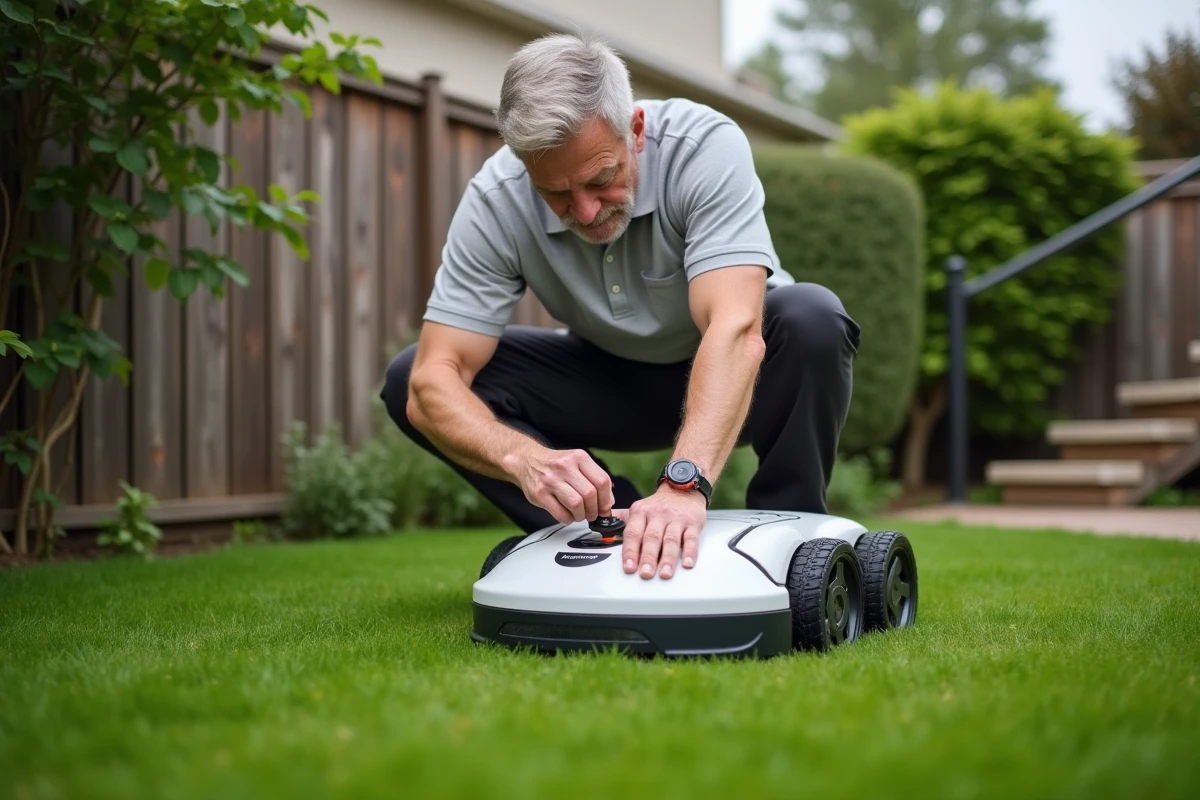
A lawn mower robot left unattended in a garden remains an easy target: lightweight, accessible, and resalable. Protection relies on three complementary levels, from integrated software locking to the physical layout of the garden, including the insurance aspect that most guides overlook.
Home insurance and lawn mower robot: what your contract really requires
Before discussing locks or GPS, the first question to address is that of compensation. A stolen robot whose anti-theft functions were not activated may simply not be covered.
Recent contracts, particularly with MAIF and Groupama (general conditions 2024-2025), require proof of activation of the integrated anti-theft functions: PIN code, geolocation, alarm. Without this proof, the insurer may refuse coverage or apply a higher deductible.
Conversely, declaring the device as “connected garden equipment” and demonstrating that the protections were active at the time of theft can sometimes lead to a reduced deductible. In practical terms, it is useful to know how to protect a lawn mower robot against theft to discourage thieves as well as to meet the requirements of your insurer.
Check the clauses of your multi-risk home insurance contract. Some policies classify the lawn mower robot as “garden goods” with a low compensation ceiling, while others link it to home automation equipment with better coverage.
- Keep the purchase invoice and the serial number in a location separate from the robot.
- Take a screenshot of the app showing the activation of the PIN code and GPS.
- Report the device to your insurer as soon as you purchase it, without waiting for a claim.

Geofencing and lift alerts: the software duo that changes the game
Most recent robots come equipped with a PIN code and a lift sensor. These two functions are a minimum, not an end point.
The real security gain comes from geofencing, or virtual zone delimitation. On models that operate without a peripheral cable (via GPS, RTK, or EPOS), it is possible to define an authorized perimeter. As soon as the robot crosses this boundary, a push notification or email is sent to the owner.
This system turns every unauthorized movement attempt into an almost instant alert. Where a PIN code blocks the use of a stolen robot, geofencing signals the ongoing theft. The two complement each other.
Lift sensor and sound alarm
When the robot is lifted off the ground, the sensor triggers a sound alarm and, on connected models, a notification on the owner’s phone. The deterrent effect is real: a device that screams in a quiet garden attracts the attention of the neighbors.
Always activate this function. On some models, it is disabled by default from the factory, which explains why some owners only discover it after a theft.
Account locking and blacklisting
Several manufacturers now link the robot to a unique user account. A stolen device cannot be reset or paired with a new account without going through customer service, which verifies ownership. This approach makes resale much more complicated and decreases the incentive for theft.
Lawn mower robot shelter as an anti-theft device: anchoring and locking
A lawn mower robot shelter primarily protects against rain and sun. But recent models go further with anchoring plates to be bolted into a concrete slab and reinforced structures.
The idea is simple: if the charging station and the robot are locked inside a shelter that is itself anchored to the ground, opportunistic theft becomes too lengthy and too noisy to remain discreet. A thief who has to force an anchored shelter, detach a bolted charging station, and disable a sound alarm usually abandons in the vast majority of cases.
- Choose a shelter with a lock or padlock, not just a lid placed on top.
- Secure the charging station to the ground with concrete screws or chemical anchors.
- Place the shelter in a visible area from the house or the street, never in a corner hidden by a hedge.
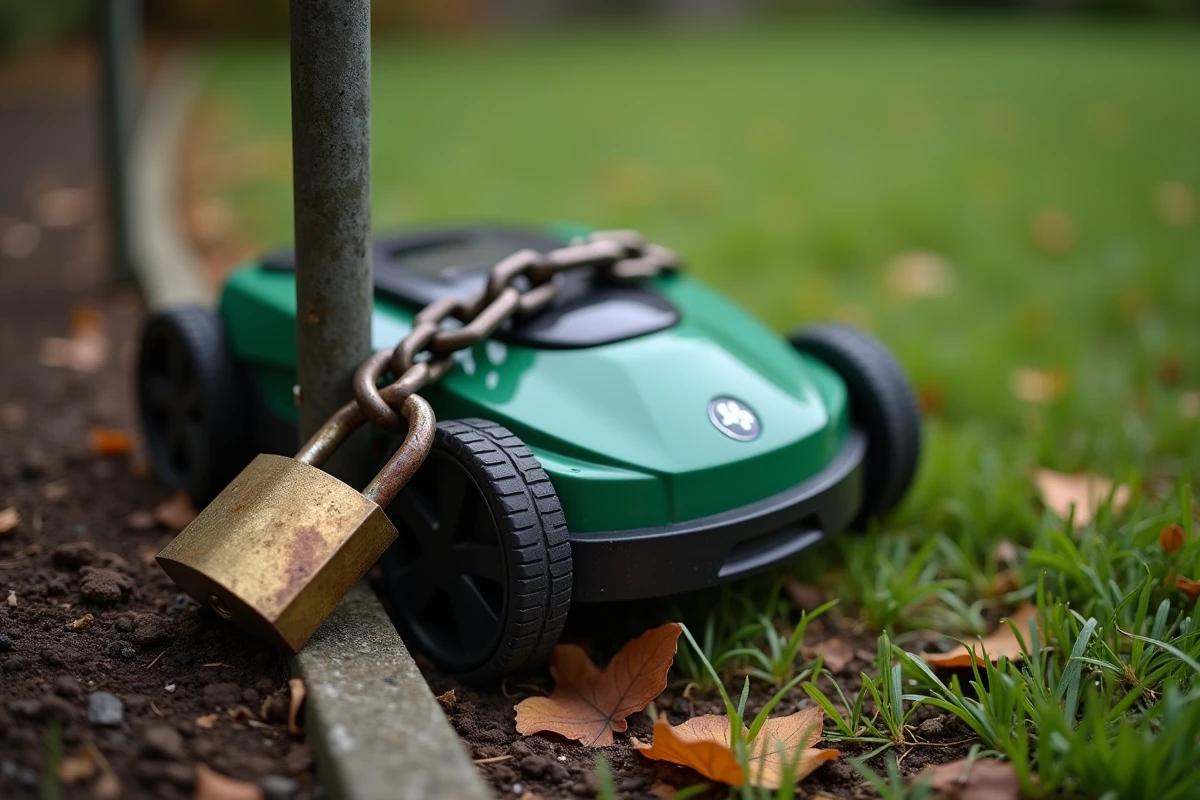
Scheduled programming and visibility: reducing exposure to theft
A robot that mows in the middle of the night in an empty garden offers an ideal window for thieves. Scheduling mowing during the day, when the garden is occupied or visible, mechanically reduces the risk.
Some owners schedule mowing early in the morning to avoid the heat. The reasonable compromise is to operate the robot during hours when at least one neighbor or occupant can see the garden.
Positioning of the charging station
The location of the base is as important as its fixation. A station installed against the house wall, facing a window, or within the range of an existing camera, is more discouraging than a base hidden at the back of the yard. The robot automatically returns to its base: if it is well placed, the device spends most of its time in a monitored area.
The combination of these different layers (compliant insurance, activated software functions, anchored shelter, thoughtful programming) forms a protection that does not eliminate the risk to zero, but makes theft sufficiently difficult and unprofitable to discourage the vast majority of attempts.