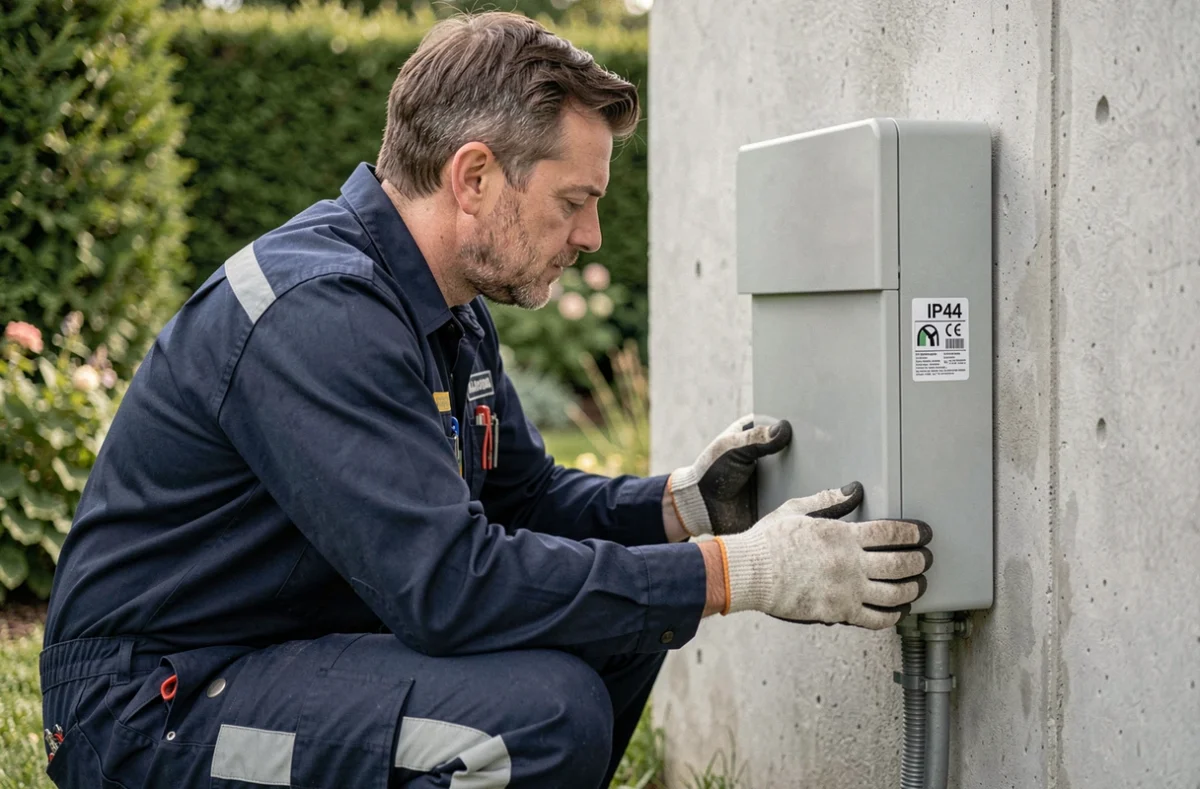
IP44 and Class II do not describe the same property of an electrical device. The IP rating indicates how resistant the enclosure is to solid objects and water. The protection class defines how the device is insulated against electric shock from indirect contact. Confusing these two markings can lead to specification errors, particularly in bathrooms, where both criteria apply and neither replaces the other.
IP44 and Class II: two independent types of protection on the same device
A light fitting can be both IP44 and Class II, or IP44 and Class I. These details are listed separately in the technical specifications because they relate to different standards.
The IP44 rating guarantees protection against solid objects larger than 1 mm and against water splashes from any direction. The first digit (4) covers the ingress of wires or fine tools. The second digit (4) indicates protection against splashing, without direct pressure.
Class II relies on double or reinforced insulation between live parts and accessible parts. No protective conductor (earth) is connected. The standard symbol is a double square with concentric outlines. For more information about Class II protection and its symbol, the marking on the product remains the only reliable indicator when making a choice.
A Class II device with an IP20 rating is not suitable for a location exposed to water splashes, despite its double insulation. Conversely, a Class I IP44 device requires a functioning earth conductor to ensure safety in the event of an insulation fault.
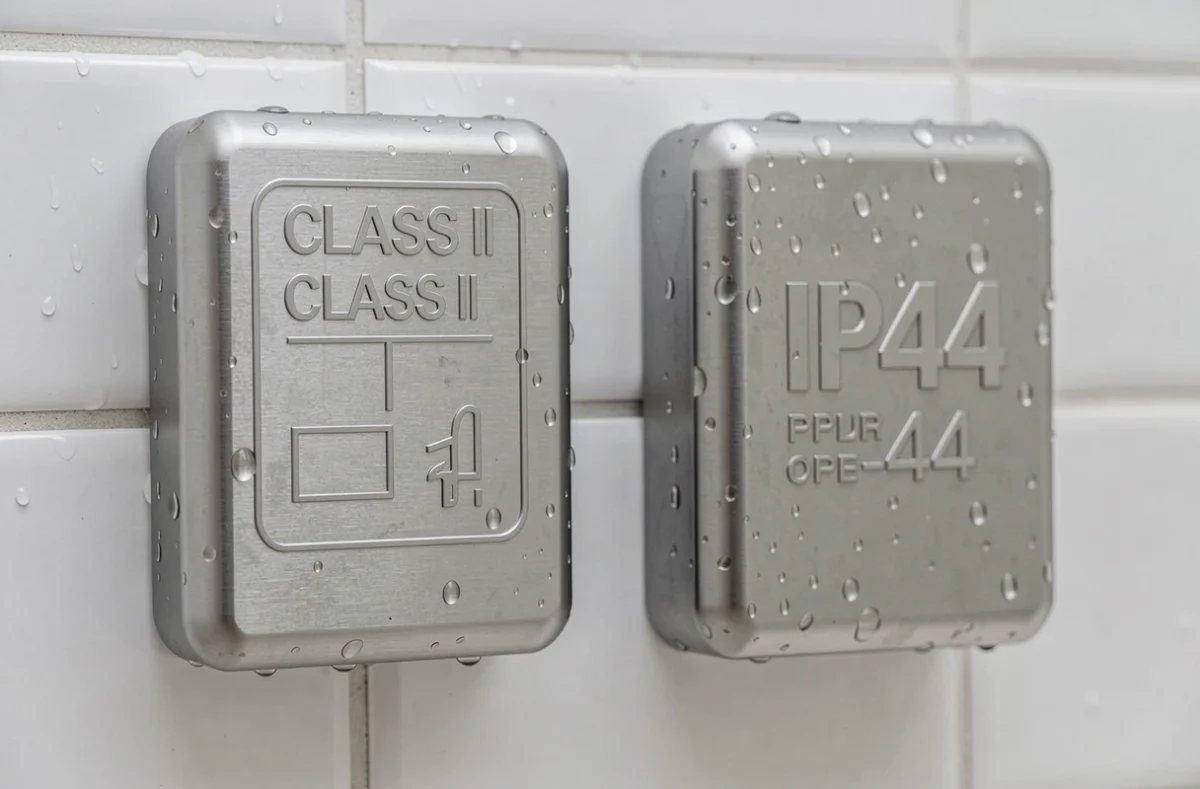
IPX4, IP44 and IP65: how to read the second digit for water protection
The IPX4 designation means that only the second digit is specified. The “X” does not indicate a lack of protection against solids; it simply means the manufacturer has not had this parameter certified. IP44 and IPX4 offer the same level of protection against water, but IP44 also confirms resistance to fine solid objects.
This distinction matters when replacing a light fitting. A device marked IPX4 installed in an area where the standard also requires protection against dust does not meet the full requirement. We recommend always checking both digits rather than relying on the second one alone.
The scale for the second digit is as follows:
- 4 – water splashes from any direction, without significant pressure
- 5 – low-pressure water jets from a nozzle
- 7 – temporary immersion to a depth and for a duration specified by the manufacturer
For a recessed spotlight above a shower, level 4 is not sufficient if the fitting is located in an area where direct water jets are likely. The choice between IP44 and IP65 depends directly on the NF C 15-100 zone in which the fitting will be installed.
Bathroom electrical zones: where IP44 and Class II requirements overlap
The NF C 15-100 standard, whose section covering rooms with a bath or shower is identified as NF C 15-100-7-701, divides the space around a bath or shower into concentric zones. Each zone requires a minimum IP rating and, in some cases, a specific protection class.
Only Class III devices (12 V SELV) are permitted in Zone 1, with a minimum rating of IPX5. Zone 2 allows Class I or Class II light fittings, provided they have an IP rating suitable for exposure to splashes.
One point that is often overlooked: the actual layout of the installation changes the boundaries of the zones. A walk-in shower without a raised tray extends the boundaries of Zone 1 beyond what a standard plan might suggest. A movable or removable screen does not reduce the zones. A light fitting near a partition may be subject to stricter requirements than its apparent distance from the showerhead would suggest.
Class II does not eliminate the need for a 30 mA RCD
The double insulation of a Class II light fitting protects against an internal fault in the device. It does not replace either the 30 mA RCD required on the circuit or the local equipotential bonding in the bathroom. These protections operate at different levels: one protects the device, the other the installation.
Installing a Class II light fitting in Zone 2 without checking that the circuit is protected by a 30 mA RCD is still non-compliant. The device’s protection class and the protections in the electrical panel complement each other; they never replace one another.
Choosing between Class I and Class II for your installation
The choice is not simply a matter of quality. Class I and Class II are designed for different installation requirements.
- A Class I light fitting requires a protective conductor (green-and-yellow wire) connected to earth. If the existing wiring has only two wires (live and neutral), installing a Class I device requires running a new cable
- A Class II light fitting can be connected without an earth, making it easier to replace one in an older installation. Safety then depends entirely on the quality of the manufacturer’s double insulation
- In renovation projects, Class II avoids rewiring when the earth conductor is missing or unreliable, provided the zone and IP rating are suitable for the location
In a new or renovated home that meets current standards, both classes offer a comparable level of safety. The difference lies in redundancy: Class I adds an earth connection as a safety net, while Class II relies solely on insulation but eliminates the risk associated with a poorly connected earth.
The CE marking and protection class symbol appear on the device or in its instructions. Checking both before purchase, along with the IP rating required for the installation zone, is the only reliable way to ensure that a light fitting is compliant for its location.