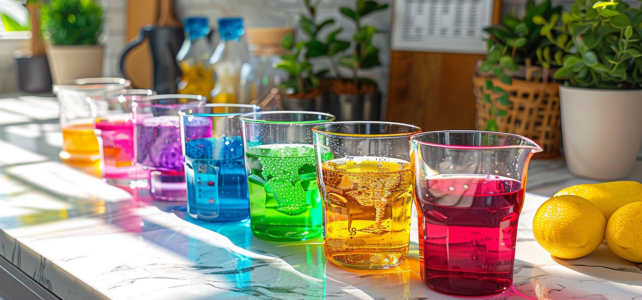
Cooking is often a precise science where mastering liquid measurement units is fundamental. Whether to follow a recipe to the letter or to succeed in a culinary experiment, knowing how to convert milliliters to ounces, or cups to liters, is essential. The variations in units between the imperial and metric systems can be confusing. Fortunately, some mnemonic tricks and practical tools exist to facilitate these conversions, allowing cooking enthusiasts to navigate easily between different recipes, whether local or international.
Mastering Liquid Measurement Unit Conversions
The conversion of measurement units is a complex process for those who have not been previously introduced to the subtleties of the metric system. Indeed, familiarizing oneself with liquid measurement units such as the centiliter (cl), the milliliter (ml), or the liter (l), requires some practice and the acquisition of basic knowledge. Take, for example, the conversion of 400 ml to centiliters: to do this, it is necessary to remember that 1 ml equals 0.1 cl. Therefore, converting 400 ml to centiliters simply involves multiplying by 10, resulting in 40 cl.
In this logic, each unit of volume measurement is in a proportional relationship with the liter, the cornerstone of liquid volume measurements. The centiliter is thus a unit of this volume measurement, corresponding to one-hundredth of a liter, or 0.01 liters. Familiarity with this information allows for relatively easy conversions, knowing that to convert centiliters to liters, one simply multiplies by 0.01.
Now let’s discuss the milliliter, often used for more precise measurements, particularly in the medical field and in cooking. One milliliter represents one-thousandth of a liter, or 0.001 liters. This distinction is crucial when it comes to adjusting the dosage of an ingredient accurately, as a conversion error could alter the desired outcome. A good understanding of the relationships between milliliters, centiliters, and deciliters, which are tenths of a liter, is therefore essential. Additionally, consider that the liter measurement, which equals 1000 milliliters, is the universal standard for liquid measurements within the metric system. When performing conversions, it is necessary to keep this fundamental equivalence in mind. Indeed, converting milliliters or centiliters to liters, or vice versa, requires handling these multiples and sub-multiples with a certain dexterity. 50 cl equals 0.5 liters, a simple yet essential conversion for anyone wishing to master the delicate art of measuring liquid volumes.
Tips and Tools to Simplify Liquid Conversions in Cooking
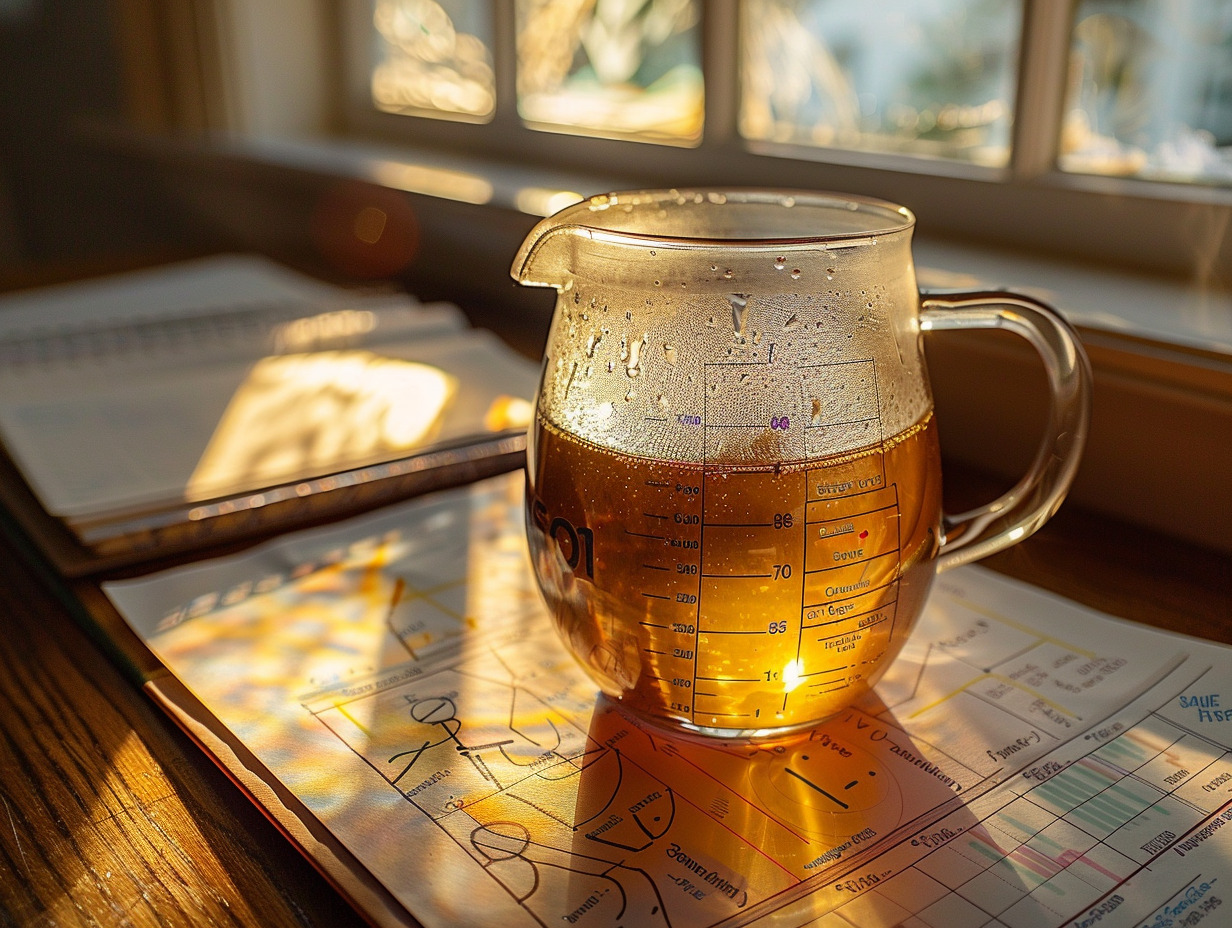
When it comes to the culinary arts, accuracy in volume measurements proves to be a determining factor for the success of recipes. For this, tools such as the measuring cup and the kitchen scale are essential allies. The measuring cup, with its markings for various measurement units, allows for a quick visualization of the necessary liquid quantity, while the kitchen scale offers unmatched precision, especially when equipped with an automatic conversion function between units.
For those who find themselves juggling different units, the conversion table serves as a valuable reference tool. Accessible online or printable to be displayed in your workspace, this table gathers the equivalences between milliliters, centiliters, deciliters, and liters. Use this table to navigate the whirlwinds of conversions without losing your way, ensuring the accuracy of the proportions dictated by your recipe.
In the face of the diversity of measuring instruments, every cook must choose the tool best suited to their needs. Some practical tips complement the use of these tools. For example, memorize common equivalences, such as the fact that 50 cl equals 0.5 liters, or that 1 dl corresponds to 0.1 liters. By doing so, you will quickly integrate this information, facilitating conversion without the need for constant reference to an external source. Measuring volume in cooking then becomes not only a matter of precision but also of fluidity and efficiency in the culinary creation process.