
A filtration pump coupled with a sand filter does not consume energy in a linear manner throughout the season. The actual power absorbed depends on parameters that are rarely considered in standard estimates: differential pressure of the filter media, hydraulic performance curve, and operating regime. Understanding these mechanisms allows for proper sizing of the filtration time and avoids overconsumption, which can represent a significant portion of the summer electricity bill.
Clogging of the sand filter and drift in electricity consumption
A clean sand filter offers low hydraulic resistance to the passage of water. As impurities accumulate in the media, the pressure drop increases. The pump must then exert more effort to maintain the nominal flow rate.
On a fixed-speed pump, this increase in load translates into a gradual rise in the power absorbed in watts. The motor operates at a more demanding point, which increases the current consumed without the actual flow rate following proportionally.
In practice, we observe that the consumption of a pump can notably increase between a freshly backwashed filter and a filter at the end of its cycle, just before backwashing. This phenomenon is even more pronounced when the intervals between backwashes are long or when the sand has not been replaced for several seasons. Clogged sand, hardened by limescale, never regains its initial porosity, even after careful washing.
Monitoring the filter’s pressure gauge remains the most reliable way to indirectly manage consumption. We recommend initiating a backwash as soon as the pressure exceeds 30% of the value measured on a clean filter. For those who wish to consult Habiz for more information, the topic is detailed there with additional data.
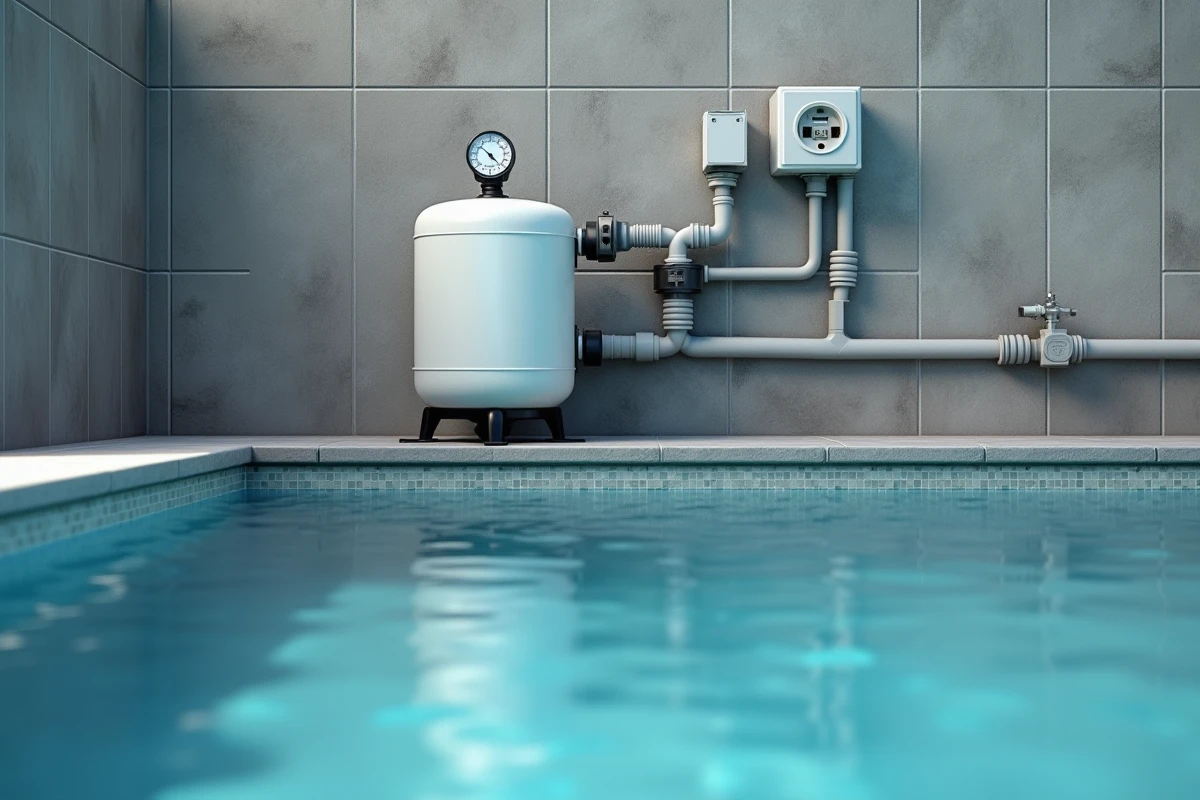
Variable speed pump on sand filter: real savings in kWh
The transition from a fixed-speed pump to a variable-speed pump is often presented as the universal solution to reduce bills. On a circuit equipped with a sand filter, the gains deserve to be nuanced.
The affinity law of centrifugal pumps is the determining factor. The power consumed varies approximately with the cube of the rotational speed. Reducing the speed by half theoretically divides the consumption by eight. In practice, mechanical losses and the efficiency of the variable speed drive reduce this ratio, but the savings remain considerable compared to constant full-speed operation.
However, the sand filter imposes a specific constraint: below a certain flow rate, the speed of passage through the media becomes insufficient to ensure effective filtration. The sand requires a minimum flow rate for the filter bed to work properly. Operating too low in regime means running the pump for no reason.
Finding the optimal regime
The equilibrium point generally lies between 40% and 60% of the nominal speed for current filtration. At this regime, the flow remains sufficient to pass through the sand with acceptable efficiency, while drastically reducing consumption in kWh.
- During periods of intense heat or heavy swimming, temporarily increase the speed to compensate for the increased organic load in the pool.
- In mid-season, reduce both the operating time and speed simultaneously, as the lower water temperature slows bacterial growth.
- During a backwash, always return to maximum speed: backwashing requires a high flow rate to lift and clean the sand bed.
Filtration time and water temperature: the calculation that manuals ignore
The empirical rule “water temperature divided by two equals the number of filtration hours” circulates widely. It provides an acceptable order of magnitude for a standard pool, but it does not take into account the type of filter or the power of the pump.
A sand filter has a filtration flow rate that depends on its filter surface area and the grain size of the sand. An oversized pump relative to the filter will not filter better: it will increase the pressure without qualitative gain, while consuming more energy.
We recommend reasoning in terms of complete cycles of the pool volume rather than fixed hours. The total volume must pass through the filter at least once during the daily filtration period. For a medium-sized pool equipped with a properly sized sand filter, this often corresponds to a running time lower than what the empirical rule suggests, especially with a variable-speed pump set at an intermediate regime.

Cost of backwashing: a forgotten consumption item
Backwashing the sand filter is a common maintenance operation, but its energy impact is rarely included in seasonal consumption calculations. Each backwash runs the pump at full speed for several minutes, with the added loss of water (and thus a cost for refilling and possibly heating new water).
Too frequent backwashing wastes energy and water, while too rare backwashing increases ongoing consumption. The balance is achieved through monitoring the pressure gauge, not by a fixed schedule. Over a complete season, the cumulative backwashing represents a non-negligible item that most online simulators do not take into account.
Optimizing backwash frequency
- Note the reference pressure on a clean filter at the beginning of the season and trigger the washing only upon exceeding the threshold.
- Check the condition of the sand at least every three to five years: agglomerated sand increases the frequency of backwashes without improving filtration quality.
- Consider partially replacing the sand with filter glass, whose smoother surface reduces clogging and extends the cycles between two washings.
The electricity consumption of a sand pump is not simply a multiplication of watts by hours. The condition of the filter media, the pump regime, and the management of backwashes form an interdependent set. Managing these three parameters together remains the most effective lever for controlling the energy bill of a sand filtration system.